Showing posts with label math. Show all posts

Monday, March 30, 2009

Got my first acceptance letter

It's from Clemson University. WOO WOO.

Still waiting to hear back from my first and second choices: SUNY Stonybrook and UH Manoa.

Also starting in on crunch time for my research. The APS meeting is the weekend of May 12th/13th and I will be presenting then. I've got some great stuff about how to improve teaching methods and retention rates for women in STEM from various studies and C.M. Steeles' work on stereotype threat. More on this later.

Tuesday, March 10, 2009

A little late, but here's something for Int'l Women's Day

I wrote it as an assignment for a math history class. I could have kept writing. Sophie Germain ROCKS! (and it's written for non-math people to read so if you want to read about a brilliant woman from Revolutionary France here you go!)

Sophie Germain – Revolutionary Mathematician

The streets of Paris were bustling with people. Marie-Madeleine Gruguelin was on an outing to the market with and her two oldest daughters, Marie-Madeleine and Marie-Sophie (just “Sophie” to avoid confusion with all the other Maries in the house) were on an outing to the market. Marie-Madeleine was reticent about taking the girls out, as the air was electric. There had been bread riots occurring with more frequency lately, the King was bankrupt, and the Estates Général had been called for the first time in a hundred and fifty years. Her husband, Ambroise-Francois Germain was asked to serve in the Estates Général, a group composed of what were called the three estates: the clergy, the 1st estate, the nobility, the 2nd estate, and the middle class, which included her husband, the 3rd estate. Everywhere people were writing pamphlets and petitions on their plights to the King. Many were unhappy with what they perceived as a lack of representation in the Estates Général. Marie-Madeleine had to concede that they would always be outvoted due to the structure of the system.
The price of bread had gone up again and Marie-Madeleine feared another bread riot. The women of the working class would instigate these whenever the prices got too high. It didn't affect her family that much as her husband had done well as a silk merchant. There was an assembly outside the Church of Sainte Geneviève; the working women saw her as their own saint. They were there in support of the Estates Général and inadvertently her husband. They were here some days and in front of City Hall other days.

“Maman, why are there so many people here?” Marie-Madeleine asked.

“They're here supporting your father,” her mother replied. “Move along, we've got to get home soon. Your little sister is waiting.”

They made their way down La Rue Clovis back to their apartment. Marie-Madeleine was taking her daughters out less and less these days and refused to take her youngest out at all. There were groups of people amassing on every street, and there were more people begging for food, for work, for money. Food prices were going up, as were taxes. There was so much unrest among the people and many with an overabundance of time on their hands due to the lack of jobs. There were often meetings held at their house. Her husband was among one of the liberal social reformers and he invited many like-minded people over for meetings. Ambroise frequently held meetings in the house with other like-minded individuals. She would continually find Sophie eavesdropping in on the meetings, entranced by what was going on. After a few tries she gave up on trying to keep her away – Sophie would always find a way to sneak back to them. None of her other daughters took any notice of the meetings except to complain that they couldn’t use the front room during these times. Sophie, despite her age, had a keen interest in the tumultuousness happening on the streets of Paris. And she had the opportunity to get the latest news from her father often in these meetings. Ambroise found it amusing that his 13-year-old daughter took such a keen interest in politics. At least this was all she was doing, Marie-Madeleine thought. After all, she could be taking to the streets to find her information and the meetings in the house were much different then those in the street. The air was becoming more desperate and Marie-Madeleine hoped for change to come soon and come peacefully, but she feared the worst. It would only be a matter of months before the Germains would be keeping their daughters inside continually.

In July of 1789 Marie-Madeleine's fears of a violent uprising came to fruition. That afternoon a group of armed people stormed the Bastille, which led to a day of bloody combat and several assassinations. Though they were part of the Third Estate, Marie-Madeleine and Ambroise-Francois felt that it would be best if they kept their children confined to the house until the city calmed down. The children did not react well to this decision. What would they do imprisoned in this house day in and day out with no end in site? Sophie took to her father's immense library to stave off the boredom. She read through everything she could.

It was here that she found a book by J.E. Montucia, History of Mathematics, and in it the story of a man named Archimedes (Osen). Sophie delighted in the odd stories of this man and his inventions, his refusals to take baths, and his obsession with mathematics. But this was not the best part of the story. It was not until she read of Archimedes' demise that she became engrossed with mathematics. The story of Archimedes' death was that as the Romans were capturing his city he was engrossed in a math problem and when engaged by a soldier he ignored that solider, enraging the soldier and prompting him to stab Archimedes. This man gave his life for geometry, for mathematics! This must be one interesting subject indeed. At that moment Sophie put down her book. What could be so interesting about mathematics that someone would give his or her life for it? She sat silently contemplating the subject until she was summoned for dinner. That night she lay in bed thinking of his circles, his diagrams, and his gadgets. Eventually she fell asleep, her mind still racing over the story of Archimedes.

The next day Sophie searched her father's library and found several books on mathematics. Many were older books, but she devoured them voraciously. She found that she would have to learn Greek and Latin in order to study Euler and Newton. Luckily her father had plenty of books on those subjects as well. Every day she spent with her father's books learning as much as she could: Latin, Greek, and about mathematics. She would work through the problems on paper, marveling in their intricate beauty. This went on for some time until one day her parents discovered how she was spending her days. It upset her mother that she was spending her days studying mathematics – this was not something that a young girl did. After dinner one night her upset parents sent her to her room without a book. She sat at her door listening to their conversation.

“This is all she does day and night! How can we keep her from this? It isn't OK for a young girl to study mathematics, especially not this obsessively,” her mother exclaimed.

“We'll just have to watch what she reads. Perhaps we shall no longer give her unfettered access to the library during the day that way we can monitor what she reads,” Ambroise-Francois replied. “There are many other places where she can sit and read since that is how she likes to fill her days. We do not have to keep such a close watch on the other children. When I am not here, if we limit her access to the library, it should not be too hard for you to make sure that she is not reading mathematics books.” The Germains were in agreement: they wouldn't let Sophie into the library on her own during the day and they would then be able to make sure that she did not continue her study of mathematics.

Sophie softly closed her door and tiptoed away from the door. She sat down and thought about ways in which she could sneak the books away from the library without her parents noticing. Surely they would keep close watch on all the books and would notice if they went missing. In that case hiding them in her room was not an option. Sophie decided that she would wait until after everyone went to bed and then go into the library and continue her studies. * Why her parents wouldn't understand her love of mathematics confused her, after all Archimedes gave his life for it, this was obviously a very important subject.

Sophie spent many nights in the library. Then one night, while she was consumed with a geometry problem, her father saw a light coming from the library. He opened the door and discovered his daughter poring over one the books that they had forbidden her to read. He immediately sent her back to her room and removed all of the candles from her room. And so it began. Sophie's parents tried everything: stealing her candles, her clothes, even cutting off the heat to her room at night. No matter what she always had a stash of hidden candles and quilts that she would wrap herself in and continued her studies. Despite all their efforts they continued to find Sophie curled up next to her books morning after morning. At this point the Germains realized that Sophie's love of learning mathematics could not be willed away or forced out of her and they allowed her free reign of the library once again. She was allowed to study mathematics freely during the day and with all her clothes.

In 1794 the École Polytechnique opened in Paris. It's mission statement was to “train mathematicians and scientists for the country”(Perl 64). The school did not admit women, but as with her earlier studies, she didn't let this obstacle stop her from learning even though she could not physically sit in on the classes. She was able to obtain the lecture notes from students in the classes and would send comments to the professors, which would at times include original notes on mathematics problems, but unlike other students she had to use a pseudonym to disguise her femaleness. And so Sophie became M. le Blanc.

During this time she became especially interested in the work of one professor, Joseph-Louis Lagrange. Lagrange was so impressed by her work that he insisted upon meeting the student who had produced it. * Upon discovering that it was a woman who had created it he was surprised, but not put off by it. He praised her for her analysis and would continue to support her and her work, becoming a mentor and a friend. Such encouragement from such a prominent mathematician energized Sophie and gave her more confidence in her work as a mathematician. With this newfound confidence Sophie moved from solving problems in her course work and into studying unexplored areas of mathematics. It was at this point that she became aware of Fermat's Last Theorem**. Fermat's Last Theorem continues to puzzle mathematicians to this day. It states that there are no solutions to equations of the form x^n+y^n=z^n where n ≥ 3.

After many years of work she believed that she had made a breakthrough in Fermat's Last Theorem. She felt that at this time she would need to talk to a fellow number theorist. After reading Gauss's Disquisitiones arithmeticae, a work on the theories of cyclometry, having to do with measuring of circles, and arithmetical forms she became obsessed with the works of Gauss. Using her alternate identity, M. le Blanc, she then sent Gauss the results some of her of work in number theory in 1804. Gauss was impressed by her findings and this began a correspondence between the two. She approached the theorem in a way that no other mathematicians had, possibly owing to the self taught nature of her education. She used a far more general approach then any of the other mathematicians of the day and this intrigued Gauss, whose contempt for Fermat's Last Theorem was well known.

In her letters she showed that she was not trying to prove that there was no solution for each equation one at a time, but instead she approached the Theorem holistically and tried to make a general statement that would cover all the equations. She focused on the equations in which n was a prime number. A prime number is a number such that itself and the number one can only divide it without leaving a remainder. For example 7 is a prime number because only 1 and 7 divide 7 without leaving a remainder whereas 9 is not since 1, 3, and 9 all divide 9 without remainders. Sophie was only interested in a particular brand of prime numbers, p, which were such that 2p+1 was also a prime number. For example 3 is a Germain prime because 2*3+1=7 and 7 is also prime. But 7 is not a Germain prime because 2*7+1=15 and 15 can be divided by 1, 3, 5, and 15 without remainders. She used these numbers to show that it was highly unlikely that any answers existed for the equation x^n+y^n=z^n, when n = p, with p being a Germain prime (as described above)**.

Had it not been for Napoleon's soldiers marching on Germany and Sophie fearing for Gauss's safety we may never have known that she was responsible for this breakthrough. We might know these numbers as le Blanc primes. Though Sophie and Gauss had been corresponding for 2 years by the time Napoleon invaded Germany, Gauss had no idea that M. le Blanc was actually Sophie Germain. Just as Archimedes' death inspired Sophie to begin her studies, so too did it weigh heavily on her mind as she thought of Gauss in Germany and the French army marching through. She worried that Gauss may suffer the same fate that Archimedes did and contacted a General friend of hers, Joseph-Marie Pernety, and asked him to guarantee Gauss's safety (Osen 85). True to his word General Pernety sent an emissary to Gauss's home to make sure that he was safe while they were in nearby Breslau, but confusion arose at the mention of Sophie's name. He did not understand why this woman was making inquiries about his safety – he had been corresponding with M le Blanc! It was after this that Sophie was forced to reveal her identity to Gauss. Upon learning of her true gender Gauss's respect and admiration for Sophie grew. For a woman to study mathematics at this time, and at this level required a high level of determination. He writes:
“But how to describe to you my admiration and astonishment at seeing my
esteemed correspondent M. le Blanc metamorphose himself into this illustrious
personage [Sophie Germain] who gives such a brilliant example of what I would
find it difficult to believe. A taste for the abstract sciences in general and above all
the mysteries of numbers is excessively rare; one is astonished at it; the
enchanting charms of this sublime science reveal themselves only to those who
have the courage to go deeply into it…Indeed nothing could prove to me in so
flattering and less equivocal manner that the attractions of this science, which has
enriched my life with so many joys, are not chimerical, as the predilection with
which you have honored it.” (Bell 1937, pg 262)(Osen, 86-87)


Sophie and Gauss would continue to correspond throughout her lifetime, though they unfortunately were never able to meet face to face.

Though Sophie's work with Number Theory and Germain primes would prove to be her most famous work, she became consumed with the work of Ernst Chladni. Chladni was a physicist who was interested in the mathematics of the vibrations of elastic surfaces in two dimensions. Chladni observed that figures would form when a bow was dragged across the edge of an elastic surface covered in fine powder. Lagrange declared that the current form of mathematical thinking would not be enough and that a revolutionary new form of analysis would be the only way that this problem would be solved. So in 1808, by order of Napoleon, the French Academy of Sciences issued a challenge for all mathematicians and scientists:
“Formulate a mathematical theory of elastic surfaces and indicate just how it agrees with empirical evidence. (Perl)”
Sophie, despite being wholly unschooled and up against highly trained mathematicians found the problem challenging and took to the task of trying to solve it with the passion that marked all her endeavors. In 1811 she submitted her first attempt in an anonymous memoir. Her mentor, Lagrange, was part of the commission that evaluated the submissions and had written that her method of jumping from a line to a surface did not seem complete or accurate. Her work was rejected, but that did not stop Sophie from working on the problem. In 1813 another competition was held. This time Sophie's memoir won her an honorable mention. As you should know by now, this was not enough for Sophie. She tried again in 1816 and this time her work Memoir on the Vibrations of Elastic Plates earned her the prize. But her win did not come without immense criticism. She had won, but the commission had not been completely satisfied with her entry, and Sophie admitted that her connection between the theory and the observation was not rigorous. Many mathematicians for this criticized her, but one may wonder if that is because they themselves could not come up with something better.

Despite this criticism she had an impact on those around her. One of the judges, M.H. Navier wrote on her paper “it is a work of which few men are able to read and which only one woman was able to write.”(Perl) Her win also thrust her into the world that she belonged to. She was welcomed into circles with other noted mathematicians of the time, and able to talk with her peers openly and not have to hide behind letters and the fictitious M le Blanc. She was not one of the most noted mathematicians in the world, and her work would finally be known as her own. She was now able to attend sessions at the Institute de France with other prominent mathematicians, and was the first woman who was able to do so.
Sophie continued to publish papers on elasticity, including one on the nature and extent of elastic surfaces. She also continued to try and perfect her theory that won her the prize in 1816. One of her papers drew heavily from the works of her mentor, Gauss, though it was widely criticized for not thoroughly understanding the potential of Gauss's theories.

In 1829 Sophie developed breast cancer. Though this became her biggest battle she continued her work in mathematics until her death at the age of 55. At Gauss's urging Sophie was granted an honorary PhD from the University of Gottengen (Osen 89), but unfortunately died before she was able to receive the award. Though she made great strides in elasticity and was one of the leading minds of her time, when the Eiffel Tower was erected and the engineers inscribed the names of those who contributed to the study of elasticity of materials of the 72 people listed her name is conspicuously absent (Osen 89). So too in her death certificate was her membership to the French Academy of Sciences overlooked as she was designated a rentière-annuitant (a single woman with no profession) and not as a mathematician.

Her work as a woman who defied the expectations and restrictions of her time is one of the most lasting parts of her legacy. Sophie Germain was not only one of the most brilliant minds of her time, and she excelled almost only through her own devices. Without any formal training and guided only somewhat through her correspondence with leading mathematicians she snubbed societal conventions and changed mathematics in lasting ways. The child of revolution, she gave us a revolution all her own and that was by following her passion and not letting the mores of the day or the obstacles that she faced dissuade her from following her heart. And mathematics is a richer field for that.

Bibliography
Osen, Lynn M. Women in Mathematics. Cambridge: The Massachusetts Institute of Technology, 1974
Perl, Teri. Math Equals: Biographies of Women Mathematicians + Related Activities. Menlo Park: Addison-Wesley Publishing, 1978.
*http://www.sdsc.edu/ScienceWomen/germain.html
**http://www.pbs.org/wgbh/nova/proof/germain.html

Sunday, January 11, 2009

Reasons I shouldn't teach

I might turn out like this:

Wednesday, June 18, 2008

Mathematical knitting

I am attempting to knit Boy's Surface for my math geek/unicorn for his birthday next Friday.

Here's what it should look like (as shown in mathematica)


I found a pattern here. It's kind of confusing, but I have a week and a half, so fingers crossed.

Wednesday, June 11, 2008

I'm a horrible student.

I haven't really studied for my DiffEQ final tomorrow and now So You Think You Can Dance is on so of course there's no studying for the next 2 hours. Heh. At least my final's not until 1 (like I'll want to get up much before then-sleep deprivation the last 2 weeks, ugh.)

But apparently I turned in the longest essay on Infrared Thermometry for my Thermal Physics class. Everyone else turned in a half and page or a paragraph. I turned in 2 pages. I do believe I should get an A. I went into a lot of detail, not just talking about the Stefan-Boltzmann equation like everyone else. If it was that easy why would it be our final? (I was in the library with the engineering books all day yesterday working on it.)

Wednesday, June 04, 2008

You know what's fun...

A homework problem that expects you to recall stuff from a course that you could have taken, oh, a YEAR ago. I'm not asking to be retaught it, but seriously if you would have told me the equation, or anything like where to find it so I could refresh my knowledge, that would be great.

I hate this class, which is a shame since I loved DiffEQs before. I mean it's not like I have homework problems that are 2-3 page BURLY derivations like in Modern Physics. Gah. I'll be done with this class (and the quarter) next Thursday. Thank Her Holy Hoovedness.

Tuesday, March 25, 2008

*smacks forehead*

So my advisor (who's in Norway atm) cc'd me a copy of his rec letter for my REU. For geometric group theory. See if you can spot the problem.

I am writing this letter to express my wholehearted recommendations for Burrow as an elementary mathematics teacher. I had the pleasure of working with Ms B both as a teacher and as an advisor. I got to know Ms B very
well and can offer strong testimony to her dedication, ability, and creativity.


Overall, I can't complain, like all letters of rec the rest is very nice. Now he's an advisor for the elementary ed program which I have never EVER been in. I think it was a little mix up, but I'm hoping that it won't be a problem. Since I never EVER want to teach elementary school and it's really different then what I want to do. oopsy.


Friday, March 21, 2008

Relief and sadness

I express mailed my REU application yesterday, the essay nearly killed me (oh grad school apps are going to be awesome).

I passed evil Moore method class. Granted it was a C, but I passed nonetheless and it will average out with my A in Abstract Algebra so it's not too bad. (And my A in Thermal Physics. Granted those grades haven't been posted, but unless I got 0's on my finals, which I can guarantee I did not get, I should be getting A's.)

When I (flippantly) mentioned that my math geek could teach in Houston (I *really* like the program at Rice, thanks Rebecca! but no matter where I go it will not be in this state or (hopefully) anywhere west of the Mississippi) his only response was that his scholarship is dependent upon him teaching in state for the next 3 or 5 years (he wasn't sure which). But he did say that the program sounded really good and we agree that I should go if I get accepted. It just makes me really really sad. He wasn't averse to the idea of moving (and he does have a job which is highly portable: high school math teacher), he just has to be here for awhile. Oh well, that is in the future, but it's still a sobering thought and one that doesn't exactly fill me with warm fuzzies.

At least I get to read and it's nice to not have classes because I get to meet up with my math geek everyday after he finishes school for coffee or an early dinner. (Since my afternoon spring break schedule consists of me buying a New York Times, going to my favourite coffee shop, yelling at the paper and talking to my friends I have neglected because of school.)

[imitation drunken coed voice]
Spring break '08. WOOOOOOOOOO!
[/imitation drunken coed voice]

Monday, March 17, 2008

To do

1) Abstract Algebra final due Wednesday
final check before turning take home in Wednesday

2) answer thermal physics final question (ONLY ONE) due Tuesday morning

3) prove ONE MORE FUCKING PROOF before Wednesday's 2 hour class proved nothing, but then neither did 68% of the class.

4) mail the Buffy DVDs I sold on Amazon this week by Tuesday

5) celebrate the end of finals and *sigh*

6) take out friend from Abstract class on wed. night for drinks starting with trivia night

7) write essay for REU

8) YAY SPRING BREAK!!!!! mmmmm *rubs hands together and ogles the pile of books on the desk*

Friday, March 14, 2008

Tips for application "essays" (REU)

I'm applying to an REU this summer in geometric group theory that I really really want.

The about blurb:
Geometric group theory lies at the crossroads of geometry, topology, and group theory, yet many of its questions can be attacked by undergraduates. In the first two weeks of the REU, we will explore what it means for a group to have a geometry. We'll start with a hands-on introduction to non-Euclidean geometries, tilings, how to draw graph pictures of groups, and how groups can act on spaces. We will also look at an assortment of groups arising from topology and geometry, such as braid groups, reflection groups, and fundamental groups of surfaces. We will discuss algorithmic questions, such as how to tell when two strings of group generators actually determine the same element in the group.


And the "Statement of Interest" is your standard 1-2 page why do you want to do this REU, what are your interests, mathematical or otherwise, your career plans (pure mathematician or mathematical/theoretical physicist? who knows?!) and other info.

What do people look for? I highly doubt that they care about my interest in circus, so I'm safe there. ;)

Also, the deadline is in 10 days and one of my prof's hasn't gotten back to me about a rec letter. I need a second and no one else really knows me that well. What do I do? FOUND!

Pi day!

SO today at 1:59 (3/14 1:59 haha) that math department showed this HI-larious video called The Great Pi/e Debate. (I would LOVE to have Garrity as one of my prof's. He's hysterical! I love it! I do like the prof's that get all crazy and yell. Branco does that all the time especially with proofs, it's highly amusing.)

I also found this:

e vs pi!

"Ladies and Gentlemen, in the one corner we have pi. First written about by Euclid, pi is the ratio of the circumference of any circle to its diameter. Pi's been baffling people for millennia with its ability to just keep going without end. And here's the thing folks, it's the same for ALL circles! you can have a circle so small you can't even see it, and it'll be pi times as big around as it is across. And then you can draw a circle around your house, and same thing. If you had a circle that went all the way around the universe, people, its circumference would be pi times its diameter."

"And in the other corner, the scrappy young e! e was studied by the mathemetician Euler in the 1700s, e certainly doesn't have as much experience as pi, and at a measly 2.71828, certainly gives up a weight advantage to pi's 3.14159, but don't let that fool you folks...e can go on just as bafflingly long as pi, and represents the limit as n approaches infinity of (1 + 1/n)n. It is the base for the natural logarithm! The graph of f(x)=ex has a slope of exactly ex at any value of x! That's right folks, it derives its OWN tangent!"

"AND WITH THAT, e takes an early jab at pi, which reels back but quickly multiplies itself by i and raises e to...-1! Oh, e is hurting people but quickly re-derives itself from itself showing pi the versatility of truly interdimensional mathematics..., pi confined merely to the cartesian plane is quickly lost in its meager foray into Complex mathematics, and tries to re-aquire geometric footing..."

"But Pi's not done here folks, the referee can't really comprehend this higher-calculus either and quickly breaks up the hold. Pi immediately starts spinning out sine waves, proving its utility to electrical and recording engineers worldwide, but e is unimpressed. Despite lying "undiscovered" for centuries longer than pi, e demonstrates its presence throughout nature in the shell of the nautilus, the expansion of the universe, and even the architectual designs of pi's Greek contemporaries."

"Pi stumbles back, dumbfounded and weakly shields itself with a large circle, but its bag of tricks appears to be running empty, and e is just getting started, as it begins to feed itself into continuously-compounding interest equations, showing off its economic maximizing potential. But it's still not done, it's now rubbing pi's face in the base-e numerical system, with the undisputed most efficient economy of numerical width times radix, leaving no doubt as to where the "natural logarithm" got its name."

"Now I must say here, folks that stylisticaly speaking, pi looks good, but e has the undeniable presence advantage, being found on every keyboard, while pi is inherently difficult to type, not even being included in the ASCII character set. Nobody's confusing e with dessert, either, and the game may be stacked here, but ln(e1)=1, while ln(pi1) is incredibly ugly."

"Pi is definitely outclassed here. It's a textbook case of a long-time champion growing overconfident in its size and inertia and getting out maneuvered by a leaner, meaner number who just wanted it more. The winner by undisputed decision and a KNOCKOUT is...."

"eeeeeeeeeeeeeeeeeeeeeeeeee"

This deathmatch brought to you by by the balanced ternary number 111, and the letter theta


(source here)

Hope this doesn't spoil this for ya, but e wins twice in one day! That's my constant!

e!e!e!e!e!e!e!e!e!e!e!e!e!e!e!e!e!e!

in other news: physics final: one question about entropy of the universe, easy. to be done on Monday with some other physics students. algebra final: done with page one, gonna do a little here, a little there, meeting with someone before wednesday (when it's due.) evil deathly proofs class: must prove at least one more thing for wednesday.

Saturday, March 01, 2008

oh my good god

1) I have an algebra assignment I haven't touched, but at least it's due Tuesday.

2) Due to all the stress this quarter I have missed 99% of the deadlines for my REUs, but I'm sure my prof's sent off their rec letters since they're awesome (I did plan ahead and talked to them all at the beginning of January and what I was missing were mostly the essays). There aren't many that start mid-June or later. Damn quarter system. There is one I didn't miss at UIUC (FIghting Illini, my dad's alma mater and only 3 1/2 hours from Chicago, huzzah!) on groups and I've all ready talked to the professor leading the REU on groups who encouraged me to apply even though I will be missing the first few days due to finals. (I did mention in the email how excited I am by groups and we have corresponded about her research which I hope will be helpful in getting into the REU).

3) I have half finished my take home physics exam, but I just have to call some of the other kids in my class because my prof conveniently forgot to lecture on it, though the second problem is missing 2 important ingredients to find the equilibrium temperature and pressure, the change in internal energy, and the change in entropy, namely the initial temperatures and pressures of the 2 systems. I emailed him about this, though.

4) I LOVE The West Wing. It's awesome.

5) My loverly math geek got up this morning and cleaned up the biohazard that was my kitchen sink. Have I mentioned how much I love my math geek lately? Anxiety severely reduces the amount of spoons (which has nothing to do with dishes) I have and my dishes have not been done in about 5/6 weeks. He is very brave and oh so awesome for doing that. *sigh* I'm so lucky.

6) I SLEPT! and I feel rested! (One does not necessarily imply the other.) I did my physics!

Wednesday, February 27, 2008

This is kind of cool: why anxiety means homework goes unfinished

My kick-ass rad fem therapist today and I were talking about (what else) the overwhelming anxiety I am having from my proofs class which is coupled with the fact that I went to see him today to ask for help and he just stared at me. (You should listen to him when people who are doing well in the class go in for help, he's super-helpful. All other C students like me say the same thing: when you ask him something he stares at you, but he'll help the people who all ready get it. Being one of 3 resources for the class (another one being his crappy definitions and the third being me, who can't figure out the definitions and is therefore struggling to stay afloat) this SUCKS.)

ANyway, back to my story. There is, of course, some PTSD triggers thrown in there as well. So much about this mirrors being in a house with my abusive mom: having to be somewhere I hate while being helpless and having no one to turn to (b/c yes I *can* get a tutor, but all the math fellows either a) tell me they did horribly at the class, b) took it from someone else and every prof covers different material, or c) blocked it out of their memory), and then there's the constant replays of my mom's voice telling me I'm stupid and a litany of other similar things. HOORAY! Isn't my head a fun place to be these days? My best friend begged me to leave the class (we have similar mental health (dis)Abilities and are always watching out for one another, but I can't. I have 2 friggin' quarters to go and I will have that BS in my hands. Can't change now, don't want to either. Like math, want to continue doing math for a very very long time. Must push through even though b/c of this class they've upped my Xanax AND my Lamictal. Heh. (and I had to double my xanax dose yesterday b/c one just didn't work)

SO, here's the cool part. My therapist likes to explain how these things work inside your brain by modeling it for me. I really like this. SO today she showed me how anxiety and PTSD affect the entire brain, not just how PTSD traps you in your midbrain (and how the techniques we use like EMDR try to put these things into words instead of just emotions which move them out of your midbrain and make them something that is easier to deal with and not an automatic reaction.)

She held out her hand in a closed fist: this is your brain (I know you probably all pictured the frying pan, but shake it out), she then opened her fist and pointed to the middle of her hand and said "this is your amygdala" and then to her thumb and said "this is your hypothalamus" and re-closed her hand. She then said "this is normally how your brain is, but when you get activated, or in a manic state, or in a mixed state (which happens to me when I get activates), or have anxiety this happens" and she opened her hand (which makes sense since in PTSD the midbrain takes over) "and your neocortex is unable to function properly."

I all ready knew that anxiety meant that I was not going to get anything done, but it's nice to have an idea of *why* nothing gets done. Although I'm sure if I had a more technical explanation I would just be confused.

Finals start the 17th, we don't have a final in this class, just a 2 hour class period of, yay, proofs that Wednesday. Everyone keep their fingers crossed that I don't have a nuclear meltdown before then, because it really feels like I am heading for a major one and I really REALLY hate the idea of having one because of something that I put myself through.

Thursday, February 21, 2008

In light of my last post


My abstract algebra midterm had a delightful question on it that was just too easy:
If G is a group in which every element is its own inverse, then G is abelian.
(HA! Too easy. I LOVE proving that things are abelian, and this is super easy. Wanna see? Too late!)

NOTE: I am not saying that if you can't do this you are not smart, but compared to other things in group theory I think this is one of the easiest things to do.

NTS. If G is a group in which every element is its own inverse, and then G is abelian.
Proof:
and


We can do the same for b.


Since we can cancel and therefore which shows that G is abelian.
QED.

I also finally just got latex for blogger to work and wanted to use it. Also, I just really liked doing this proof. It's fun, and did I mention easy?

Wow, this explains A LOT!

So, thanks to wonderful women science bloggers from my blogroll (like Science Woman and Mad Scientist) I have found an article about Imposter Syndrome that is in this week's Science Careers.

"Impostor syndrome" is the name given to the feelings that Abigail and many other young scientists describe: Their accomplishments are just luck or deceit, and they're in over their heads. The key to getting past it, experts say, is making accurate, realistic assessments of your performance. Perhaps equally important: knowing you're not alone. Abigail thinks that sharing her feelings with other people is how she will eventually come to grips with her sense of feeling like an impostor. "It's fantastic to hear other people say, 'I've felt that way, too.' "


It's a feeling I get often, thinking that I have somehow gotten this far in math and physics by dumb luck or cheating, though I have never EVER done the second one, but I still feel that somehow I *must* have done something to warrant it. Example: For abstract algebra we get notes for a test, and I know there will be T/F problems on it, and I have space left on my sheet because I've all ready written all the definitions, proofs, and theorems that I can not easily remember or access (my brain looks just as messy as my work space), so I type up all the T/F questions with the answers (I've had the prof before and know they'll be the same questions). I got them all right when I answered them on the homework, and I have horrible test anxiety, but it feels like I'm cheating, even though I know the material well, having A's on the homework and knowing that other people in the class (who are mostly math fellows and grad students) are doing the *exact* same thing that I am doing. It feels like cheating, but I'm still doing it, because I know it's a big portion of my grade and to be honest, I can do homework, I can help people, I know the material inside and out, but I bomb on tests. ALWAYS. It's why I've gone from an A to a B in some of my classes. The damn final.

I get extra time on tests because I have a severe anxiety disorder. I am getting a tutor for my proofs class because (dis)Ability resources stepped in and intervened because I was having anxiety attacks every time I did the homework and even one in class the other day. This is the class we're supposed to do Moore Method though the way it is described in the link sounds wonderful compared to the way my class is run. *I* do not learn well this way, not at all. A few of my classmates told me that they are fine with this and expressed concern over my anxiety problems (it's a small department and one of them is a math fellow and I tried to keep this away from them since I didn't want to lord it over them, but they found out). This is obviously something that is warranted due to my disability, but it still feels like it's an unfair advantage over others (though I'm sure that they don't have to get up and take a walk around the building to calm down during a test as to keep from having a full blown anxiety attack.)

I have passed classes I've never studied for, and actually done really well. So why do I feel like I somehow don't deserve this? Like I won't be able to survive grad school or post-grad school research (I want to go into research) because somehow someone will discover that I can't do it, that I'm incapable, that I don't know what I'm doing, that I'm horrible at math and physics. I'm 2 1/2 quarters away from completing an undergrad degree in mathematics (the last quarter being computer programming and math history being the only required classes, so really only one more quarter of real math classes (I am also taking quantum mechanics b/c I'm a geek and may be going into mathematical physics)) and I have to constantly remind myself that I AM smart, that I DO know this.

It's strange that I have to continually remind myself of these things so close to my goal. I am passing my proofs class, even through all the anxiety (which up until I was told I could have a tutor was giving me such horrible anxiety I was unable to sleep for the first 6 weeks of the quarter), and I am IN LOVE with my abstract algebra class. It was really tough for the first assignment, but the last one was easy, I was helping other people out with their homework, and I was LOVING it. I'm confident that I will do well on the test tomorrow. I love this stuff and am seriously considering going to graduate school for it. It's fun and it comes really easy for me. But I still feel like there's a catch. But I'm just going to try and beat it out of my head. I may not be a grad student or a professional, but knowing that other people feel this way is v v helpful. I CAN do this, and I AM good at this.

UGH. I hate this ridiculousness.

Tuesday, February 19, 2008

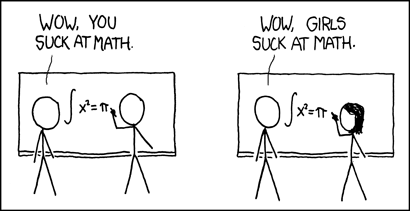
How it works from xkcd


*sigh*

Wednesday, February 13, 2008

Anxiety attack in math class today

I almost started screaming at someone in class today (do you *really* need to prove 3 things in one class when you were the one who proved the most proofs for the "first 3rd". You only raise the bar for the rest of us who were ecstatic (and I'm not the only one) of proving 3 in the last period, now we'll have to do more. We're 2 weeks in and I have none, but then again every time I try to do a proof I have an anxiety attack.) But (thankfully) instead I had a *quiet* anxiety attack and cried for the last 30 minutes of my class. It was AWESOME.

So here's the email I just shot off to my advocate at disability resources:

I have a math class in which my anxiety has got progressively worse in as
the quarter goes on. It's Math 312, Intro to Proofs via Elementary
Analysis. The style of the class is "teach yourself." We are given
definitions and sometimes theorems that, frankly, I do not find
illuminating or helpful and I do not find the prof helpful either. We're
not allowed to use any other resources, other people, books, etc.

Prior to today I was only having anxiety attacks every time I attempted to
do a proof, but today I had an anxiety attack during class. I am having a
horrible time and this class has just made my depression and my anxiety
worse. I can't get myself to school sometimes because of this class. And
I know it's going to get worse. I don't think I will be able to make it
through this class, but it's a requirement.

Is there anything you can do? I have to pass this class, but I don't
think I'll survive this and with only 2 quarters left, and full with the
rest of my requirements I don't think I'll be able to fit it anywhere else
(and everyone teaches the class this way).


Need I say again that I think this class is incredibly unfair to people with anxiety disorders (like me).

Oh and for good news, 48/50 on my Abstract Algebra homework (both points lost were ridiculous, they were things I knew that I forgot to put into my proof. ARGH!) Pure mathematics ROCKS!

Sunday, February 10, 2008

i will, i will, i will

I WILL leave the house in time to go to school tomorrow.

I WILL go to EVERY class, even if one of my prof's doesn't lecture on the material (our test on Wednesday had questions from 3 chapters ahead of what we were assigned to study. WHo does that? No reading, no lecture, no homework. I have no idea how the hell we were supposed to know that. I just looked up temperature in the index and read EVERY section on it until I got to the relevant one.) , the other prof lectures straight from the book, and the last class is the evil proofs class where I desperately feel as though I will fly into a blind rage or cry at any given moment.

I WILL finish that damn proof I've been working on for 3 hours. (mixing delta/epsilon proofs with cluster points and continuity (but at least it's a closed set and I *know* how to do it in a hand wave-y way, but not a "rigorous" way *sigh* I can explain the concepts and how it will work, but how to put it all together to form that whole crappy rigorous proof thing, bah. Have I mentioned lately that I hate this class? He doesn't like it when I turn in proofs written in the style that my 401 prof likes them to be written. ARGH. At least I get A's for those assignments, so it's not that I can't write proofs, just not these (since I can't use a damn book)))

I WILL get up 2 hours early to go to my prof's office hours so I can finish said proof.

I WILL do my physics homework tonight, even though I will have an hour between office hours and class tomorrow.

I WILL drink that glass of wine tonight so that I can make sure I will actually sleep so I can get #' 1, 2, and 3 done.

I WILL FINALLY call the doctor's office and make that appointment to up the dose on my medication that I so direly need since I've had a "low mood" (nice euphemism for depression) for the past 3 weeks.

Ugh. *fingers crossed* these things actually happen.

Tuesday, February 05, 2008

copperboom

Finished abstract homework, evil moore method class taken today, and my thermal physics prof told us that the test is "you can use anything except the person next to you."

Not so stressed anymore.

Monday, January 28, 2008

Moore method sucks, but...

SNOW!!!!!!!!!!! SNOWSNOWSNOWSNOWSNOWSNOWSNOW 1-2 inches tonight predicted.

You know what, Rice's applied mathematics programs look AWESOME, but I don't know if I can handle more years (what 5, 6 for a PhD?) without snow. Or tons of leaves and brisk weather in fall or thunderstorms in spring. Hot summers they do have. Nothing makes me happier then taking a nice long snow walk.


Oh, and SNOW!!!!!!!!

EDITED TO ADD: I just saw the forecast for tomorrow!!!! Scattered snow showers with snow becoming steadier and heavier late in the day. Thunder possible. High 37F. Winds SW at 10 to 20 mph. Chance of snow 80%. Snow accumulating 1 to 2 inches.

Did you see that! Snow AND Thunder! I will be in HEAVEN!!!! There will be dancing and rejoicing and I will be able to (temporarily) forget the evilness of my math classes.

Sitemeter